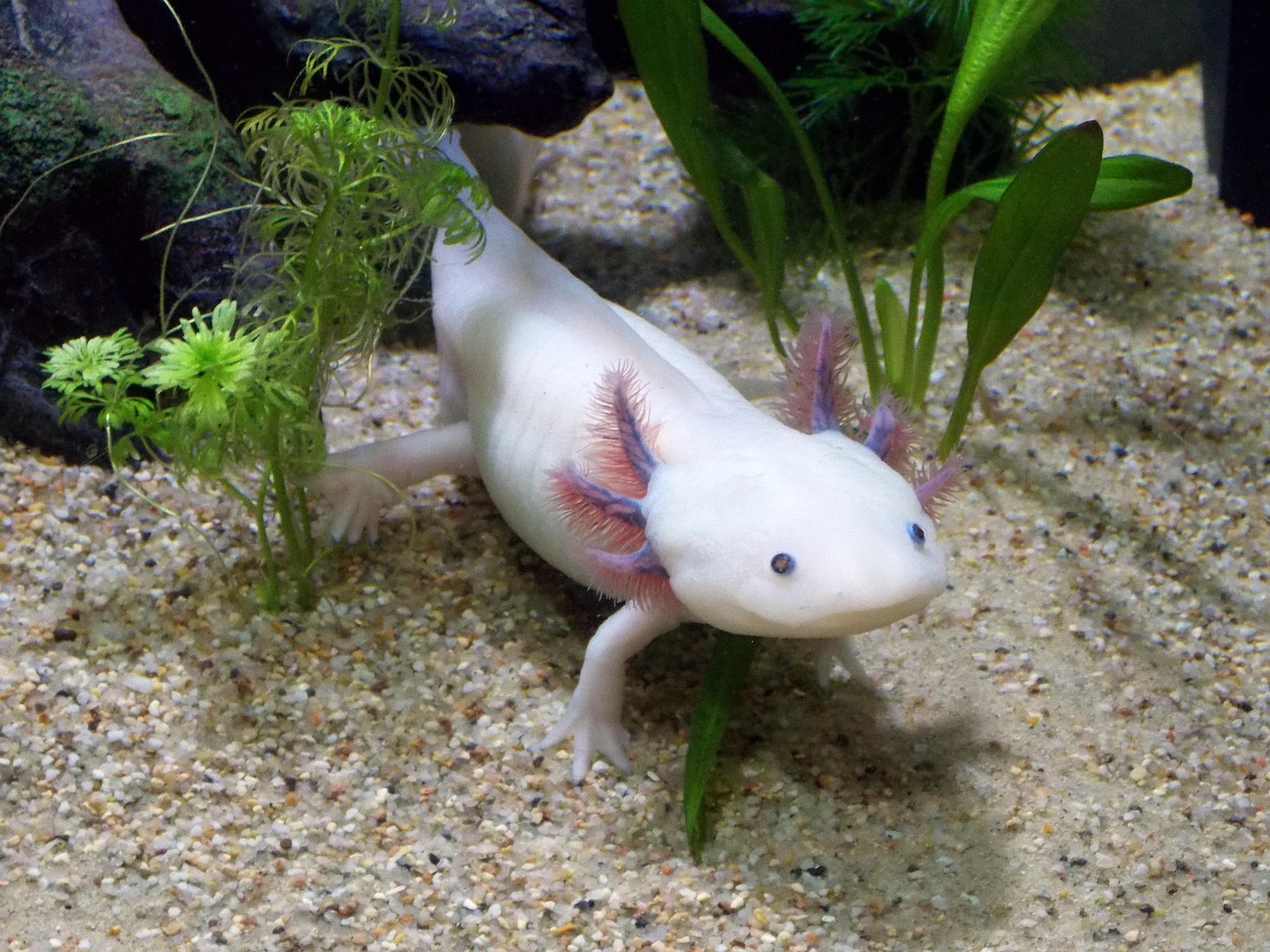
Over Thanksgiving weekend, my family visited the Gatlinburg Aquarium, where I spent far too long in front of the axolotl tank. I have always been charmed by these happy looking creatures and awed by their ability to regenerate. So I went looking for a fable about axolotls. When I couldn’t find one, I decided to write it myself.
In the time when the world was still learning how to survive itself, there lived a small, smiling creature in the cool waters of an ancient Mexican lake. The axolotl – a Nahuatl word meaning Water Dog – looked unfinished to those who passed above, soft-bodied, feather-gilled, forever young. Unlike its salamander cousins, it never rushed onto land. It stayed where it was born, cradled by water, carrying its youth into adulthood like a quiet vow.
The elders once said this was stubbornness. The scientists, much later, would call it neoteny, the rare and beautiful condition of reaching maturity without abandoning one’s original form. But the axolotl did not know the word. It only knew that staying was not the same as stagnation.
When harm came to the lake, the axolotl lost a limb. And it grew another! If its spinal cord was damaged, it healed. Even parts of its heart or brain could regenerate, perfectly, without scar. Inside its cells lived instructions for how to survive injury, and how to remember itself afterward.
This wasn’t a magic trick, but biology at its most hopeful.
Where humans rush to seal wounds with scar tissue, the axolotl pauses. Its cells return to a more flexible state, then carefully rebuild. Bone becomes bone, nerve becomes nerve, skin becomes skin.
The other creatures of the world watched with disdain.
“You should move on,” said the domesticated dogs.
“You should harden,” said the reptiles.
“You should hurry,” said the rats and rabbits.
But the axolotl stayed, and by staying, taught the lake something vital.
One evening, when the water was glass and the stars were studying themselves, the Gods of Becoming returned. They had given the world speed, ambition, and fire. But they had not given it enough repair.
They asked the axolotl, “Why do you resist transformation?”
The axolotl answered by regenerating.
The gods understood then. There is more than one way to evolve. Sometimes evolution favors those who adapt by changing form. Sometimes it favors those who adapt by learning how to heal.
So they hid a quiet gift inside the axolotl’s genome, a living library scientists would one day read. Today, researchers study axolotls to learn how humans might repair spinal injuries, regenerate nerves, and reduce scarring. The axolotl has become a teacher across species, across centuries, offering its small body as evidence that biology is not only brutal, but also compassionate.
And the fable bends toward us here.
Because we live in an age that worships reinvention. We are told to optimize, upgrade, pivot, transcend. When we break, we are urged to move on quickly, to scar neatly, to call it resilience.
But the axolotl offers another path.
What if healing is not weakness?
What if staying soft is strategic?
What if the future needs fewer reinventions, and more regenerations?
In a world flooded with information, outrage, and urgency, our nervous systems are fraying. We are injured not by claws or drought, but by speed itself. The axolotl reminds us that life did not only evolve to outrun danger. It also evolved to repair damage when danger could not be avoided.
Sometimes the bravest thing a soul can do is slow down enough to remember its original design.
So if you find yourself feeling unfinished, tender, or out of step with a world that demands constant becoming, remember the axolotl.
It did not rush onto land. It did not harden to survive. But it still healed.
And perhaps that is the quiet science-backed miracle we need most right now. The proof that staying, restoring, and becoming whole again is not defiance of nature, but is nature, at its most wise.

