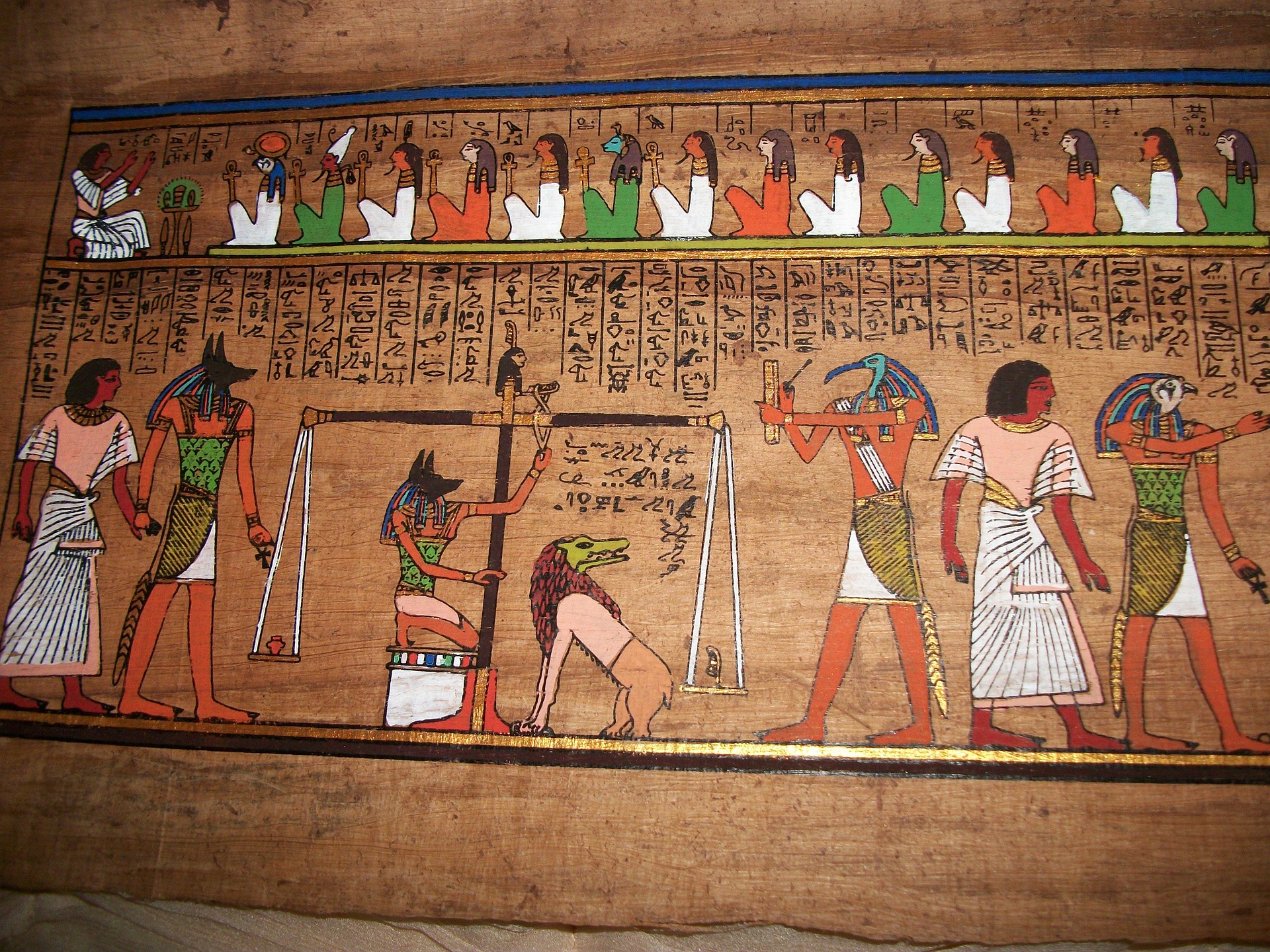
Like all the best stories, the Egyptian myth of Anubis begins in a tangle of love and deceit.
Anubis was born to Osiris and Nephthys. Now Nephthys is the wife of Set, who just happens to be Osiris’s brother and rival. Disguised as her sister Isis, Nephthys conceives Anubis with Osiris in secret and Anubis is born into the in-between of loyalty and betrayal.
Fearing Set’s wrath, Nephthys hides the infant in the desert, where he is later found and raised by Isis, the great mother-magician of compassion.
Set eventually learns of the deception and dismembers Osiris, scattering his body parts across the scorched and barren land. But a now-grown Anubis and Isis gather the pieces, carefully wrapping and preserving Osiris’s body so that he may pass into the afterlife.
Through his willingness to tend to what was broken, Anubis becomes the guardian of the dead. Often depicted with the head of a jackal, Anubis is linked to the wild dogs that roamed desert cemeteries, feral creatures who lived at the boundary between the living and the dead. Anubis becomes their sacred counterpart, a protector of graves, a watcher of thresholds, ultimately overseeing The Hall of Judgement ceremony. This ritual weighs the heart of the deceased against a feather. The feather belongs to Ma’at, the principle of balance, of cosmic harmony. If one’s heart was heavy due to immorality or selfishness, the scales won’t balance, and the Afterlife is denied.
It’s the truth and tenderness of your heart that is ultimately measured. Not your achievements or financial success. Not the story you’ve curated for others.
This can leave one feeling despondent. Won’t all true souls tremble at the scales, full of doubt and regrets?
I worried too much.
I failed people.
I doubted myself.
But Anubis understands mortals in the same way he understands mortality. He’s a Big Picture kinda guy, overlooking small specifics toward a deeper understanding of a life well-lived. He reminds us that good living is a devotion of attention. The heart grows heavy not from failing, but from forgetting to live while alive.
Do you notice the morning when it arrives?
Do you soften more than you harden?
Do you offer even small kindnesses when it’s easier not to?
Do you return, over and over, to awe?
The scales settle by sincerity, not perfection. By a quiet, repeated choosing of life. The soul may then enter Aaru, a lush, fertile realm of flowing waters and abundant crops, where souls are reunited with loved ones. Until then, we needn’t live perfectly. We balance the cosmic scales when we remember to live at all.

